

Benefits of an Environmental Data Management System (EDMS)
Managing environmental data can be labour-intensive, involving numerous repetitive tasks that are time-consuming and prone to human error if not managed effectively. This, in turn, can significantly affect the quality of the environmental data collected and, subsequently, a company’s environmental compliance.
There is a way to improve your environmental data management and reduce the time spent on repetitive tasks and the potential for human error: the effective use of an Environmental Data Management System (EDMS). The effectiveness of an EDMS can be split into the main stages of environmental data management: Plan-Do-Check-Act.
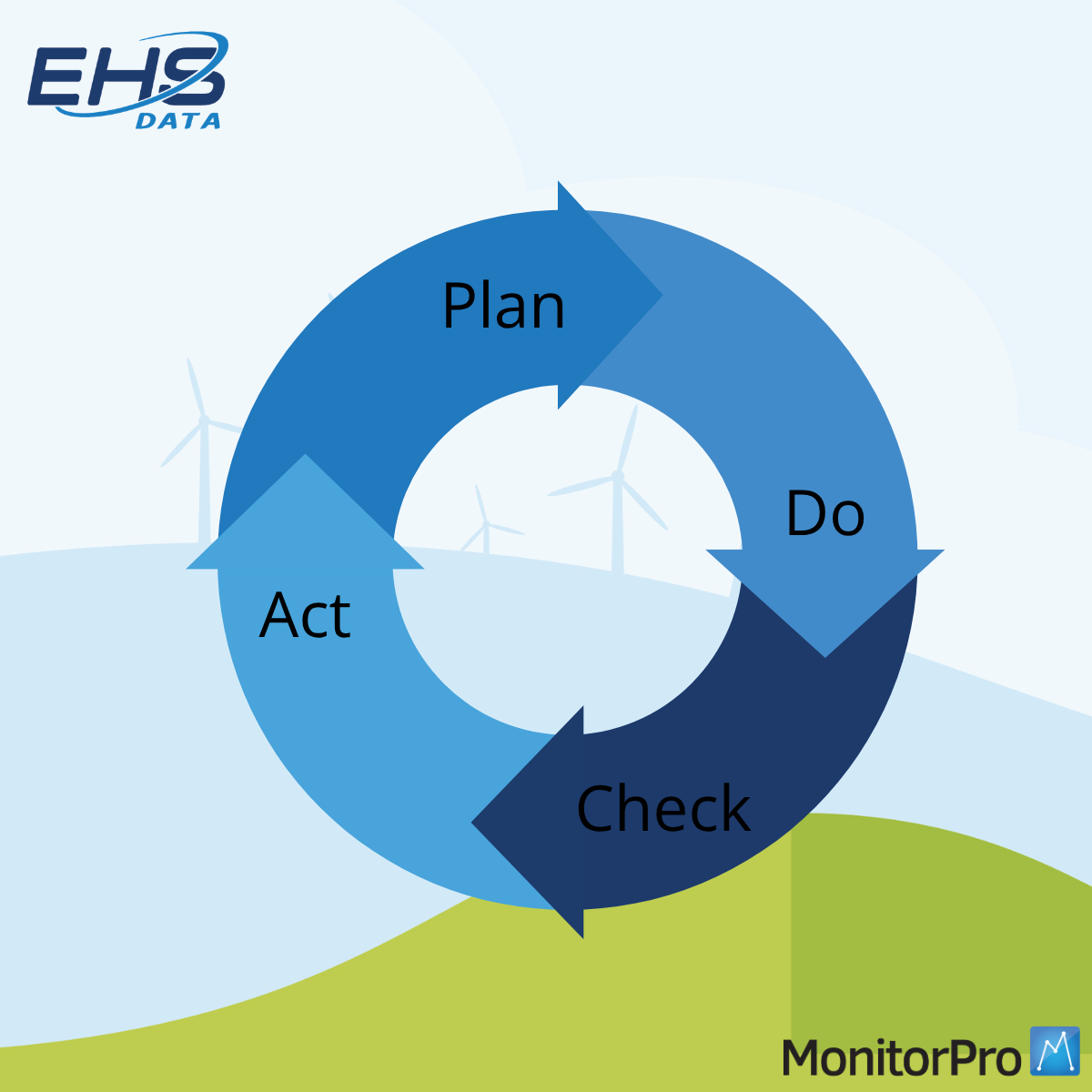
Stage 1: Plan
An environmental permit will outline what monitoring is needed, where to do it, and at what frequency. It will also identify any compliance limits and reporting requirements. These permits therefore require a structured plan to ensure these requirements are met. Therefore, a good EDMS system must facilitate the generation of a suitable monitoring plan.
Stage 2: Do
Once visits have been scheduled and created, it is important that an EDMS can clearly communicate what information is required and where to the technicians. Ideally, the EDMS will support some form of in-field data capture which can be done while offline. It should also ensure data can be easily synced and uploaded into the database and minimise any data input errors. In addition to collecting environmental data in the field, an EDMS should make importing additional data, such as lab results or weather data, easy.
Stage 3: Check
It is important that an EDMS not only identifies what needs to be collected, by whom, where, and when, but also alerts relevant users if something is missed, since missed sampling can result in data gaps and non-compliance issues. The validation of input data is also important to ensure incorrect values are not entered into the database, a problem which often occurs when using multiple spreadsheets and the copying/pasting of data, along with data input errors when typing in field data at a later date.
This means an EDMS needs to ensure that it not only aware of the data that has been received, but also aware of data that is due to be collected, and subsequently what data is missing. In the case of missing data, it needs to be able to send reminders and warnings to users highlighting that further action is required.
To ensure data input errors do not occur in the database, an EDMS should have built in validation features which set physical minimum and maximum values for input variables and any values which are received above this value should be rejected as invalid data.
An EDMS should also contain features to simplify the analysis and onward reporting of data in the database, including comprehensive calculations on data in the database, graph analysis, exporting formats for authorities/regulators, and other software systems such as GIS, removing the need for copy and pasting data from one place to another, which can result in errors entering the data.
Stage 4: Act
An EDMS must be able to immediately notify the required user (and regulators, if required) when a compliance breach is detected so the appropriate action can be taken. The EDMS should also be able to include other relevant data contained in the database, such as previous breaches over a certain timeframe. Even if a breach hasn’t occurred, regulators will require the submission of reports at predetermined intervals, and an EDMS should be able to automatically generate and send these reports.
Completing this with an EDMS is much simpler and less time consuming than using spreadsheets or paper records.
Having the ability to create an action plan within an EDMS is a key feature; these are often a legal requirement and provide a way for a site to manage its response and resulting actions following a breach, ensuring all required steps are completed within a designated time frame.
¿Quiere saber más?
To discover how MonitorPro meets these requirements check out our Benefits of an environmental data management system article, which highlights how MonitorPro’s features make it the perfect EDMS solution in each stage of Plan-Do-Check-Act.
Acerca de MonitorPro
The complete, professional environmental data monitoring solution, MonitorPro is the IT solution trusted by environmental teams worldwide to manage their environmental compliance and data collection. MonitorPro is a web-based or locally hosted solution for the collation of ALL sources of environmental data, where it is generated by loggers, laboratories, weather stations, calculations, or other data repositories. MonitorPro is the first EHS Software solution to receive an MCERTS accreditation from the Environmental Agency.
Acerca de EHS Data
EHS Data es una empresa de software líder en el Reino Unido que ofrece soluciones de gestión de datos medioambientales a más de 1.000 centros en 40 países de todo el mundo. Durante más de 20 años, nuestra versátil solución de software, MonitorPro, ha ayudado a las organizaciones a ahorrar tiempo, mejorar la planificación, el control de calidad, el análisis de emplazamientos y la elaboración de informes para gestionar las obligaciones medioambientales y la sostenibilidad.
ISO 27001
EHS Data cuenta con la certificación ISO 27001.
A Carbono de carbono
En 2020, EHS Data alcanzó el estatus de carbono negativo y se compromete a mantener este estatus cada año.